For Immediate Release: A Statement From Maldek House
Every so often a piece of popular culture reaches into the archive of forgotten cosmology and pulls something out into the light. This week, Star Trek: Strange New Worlds did exactly that. Warning: Spoilers
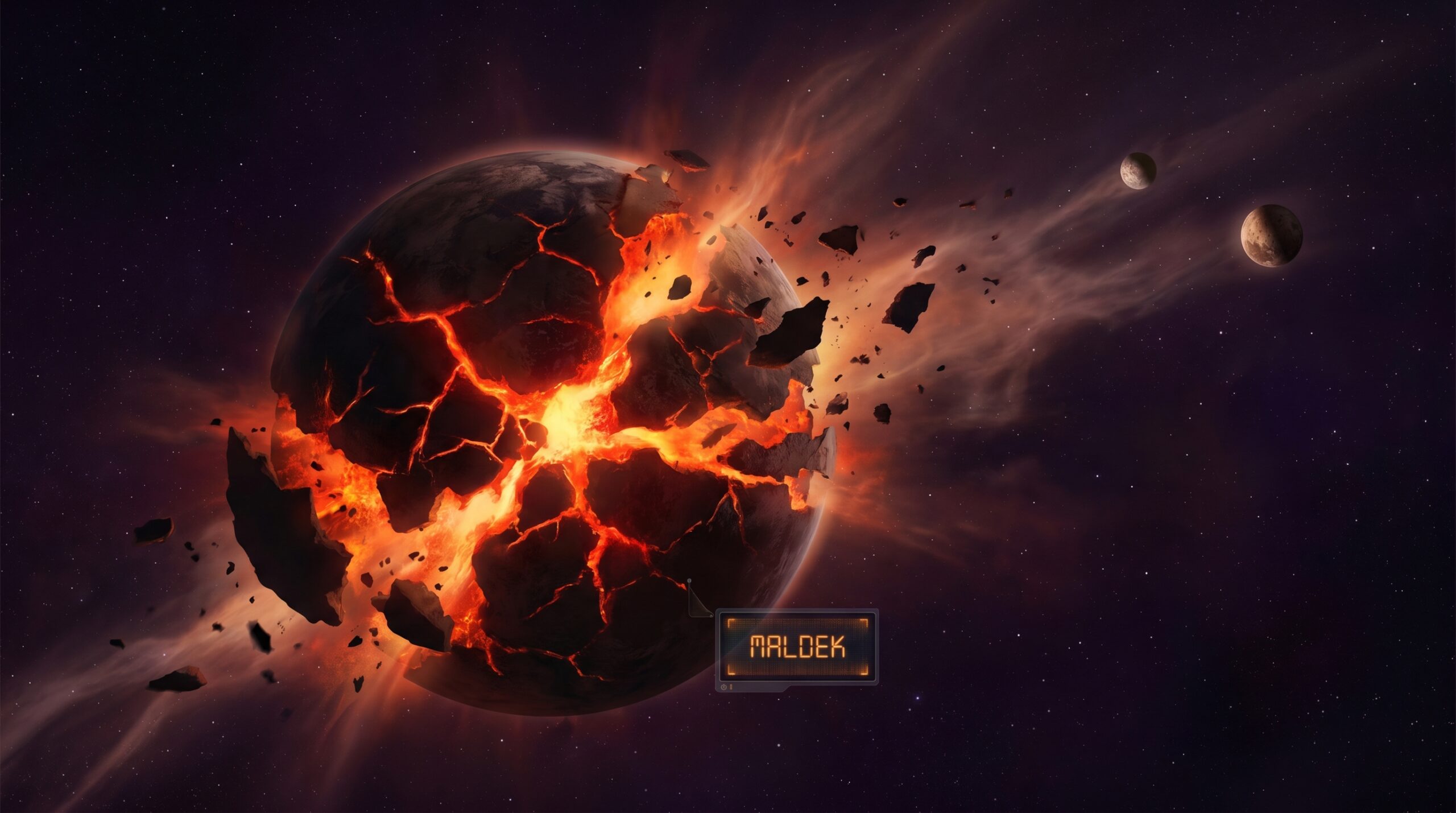
The season four premiere, Valles Marineris, Teleplay by Akiva Goldsman and Henry Alonso Myers, story by Henry Alonso Myers & Alan B McElro, sends the Enterprise sixty-five million years into the past and drops the crew into a war between a technologically advanced Mars and an arachnid species inhabiting the fifth planet of the Sol system (where the asteroid belt is now.) Antimatter is taken from the Enterprise. The fifth planet is destroyed. Its debris forms the belt, one fragment becomes the Chicxulub impactor, the dinosaurs die, Mars is shifted into a colder orbit and desiccates, and mammalian life on Earth is permitted to begin.
To the writers, producers, and cast: thank you. For the first time in decades, the destroyed fifth planet is being discussed at scale. On podcasts, in reviews, in comment sections, at dinner tables. That is not a small thing for an idea that has spent two centuries oscillating between astronomy, theosophy, and the fringe.
Maldek House takes its name from that world. We are a small independent press, and we have never pretended to hold a monopoly on a planet that belonged to everyone before it belonged to anyone. So we applaud the episode without reservation. And, in the spirit of the archive we work from, we offer some notes.
What the episode gets right
The disruption hypothesis is real, and it is old. The idea that the asteroid belt is the wreckage of a planet was formalised by Heinrich Wilhelm Olbers in the early nineteenth century, prompted by the Titius–Bode spacing law’s insistence that something ought to occupy the gap between Mars and Jupiter. The hypothetical world was usually called Phaeton. The episode’s “Disruption Hypothesis” framing is a genuine piece of astronomical history, not invention.
The Chicxulub connection is defensible. The impactor that ended the Cretaceous is now widely characterised as a carbonaceous chondrite. i.e. material of outer-belt origin. An episode that routes the dinosaur-killer out of the asteroid belt is not straining. The dating is also correct to within the resolution of the argument: the K–Pg boundary sits at approximately 66 million years.
The delivery-time problem is acknowledged. One of the quieter pleasures of the episode is that it notices that an asteroid does not simply drift from the belt to Earth on a whim; ordinarily it requires millions of years of gravitational shepherding. A violent, directed ejection solves that. It is precisely the argument the exploded-planet theorists have been making since the 1970s.
And the mass objection is not the closer it is usually treated as. NASA’s standard rebuttal is that the entire belt totals roughly four per cent of the Moon’s mass and therefore cannot be a planet’s remains. Unfortunately, this assumes the debris stayed put. An explosion does not have that courtesy. The overwhelming majority of the ejecta would have been thrown clear of the inner system entirely, into cometary orbits, into the Sun, or out of the solar system. What is left in the belt is not the planet. It is the residue that failed to escape.
Where our sources disagree with the episode, with science, and with each other
We publish in a field where disagreement is the normal condition. Here is where “Valles Marineris” parts company with the traditions Maldek House draws on.
1. The name. The episode does not call the fifth planet Maldek. It calls it the Dol’drm homeworld. This matters and we are glad of it. Maldek enters the record through George Hunt Williamson in the 1950s and passes into the theosophical and channelled literature from there; it is a name with its own lineage, its own claimants, and its own contradictions. Star Trek has told a Maldek-shaped story with a Star Trek name, and the older tradition remains exactly where it was, namely open, contested, and unowned.
2. The date. Sixty-five million years is one answer among many, and it is at the extreme end. Portions of the esoteric literature place the destruction at roughly five hundred thousand years ago. Other strands compress it dramatically further, tying the event to the loss of Atlantis and to an axial disturbance within the last twelve thousand years. Tom Van Flandern’s exploded-planet work, which is astronomy rather than channelling, proposed multiple breakup events, with a more recent one in the low millions of years. Anyone who tells you the date is settled is selling something. We include ourselves in that warning.
3. Who destroyed whom. This is the sharpest divergence. The episode has Mars destroy the fifth planet. The dominant channelled account, which is currently the Ra material of The Law of One, has Maldek destroy itself, through a service-to-self civilisation that acquired technological capacity faster than it acquired judgement. A third tradition, and the one we find hardest to dismiss, reverses the episode entirely: it was Maldek’s destruction that killed Mars, scouring its atmosphere and leaving the scarring that the northern hemisphere still carries. In that reading Mars is the casualty, not the aggressor, and the Valles Marineris of the title is the wound, not the war crime.
4. The orbital rearrangement. The episode places the shifting of Mars’s orbit simultaneously with the explosion. Mainstream planetary science places the loss of the Martian magnetic field and the stripping of its atmosphere billions of years earlier, and by an entirely different mechanism: solar wind, not gravitational relocation. Meanwhile the catastrophist tradition, such as in Velikovsky’s Worlds in Collision and its descendants, insists the planets moved far later, within the span of human memory and human record. Three positions, three timescales, no reconciliation. We think that is interesting rather than embarrassing.
5. The souls. No dramatisation is obliged to include this, and we do not fault the episode for omitting it. But the channelled literature is not primarily interested in the mechanics of the explosion. It is interested in what happened to the soul population who, with reference to the Ra account, could not simply cease. Their reincarnation into third-density Earth life is, in that tradition, the actual story. Star Trek told us how the planet died. The older sources are more concerned with where its people went.
For readers who want the primary material
These are the sources the argument is actually built on.
- George Hunt Williamson, Other Tongues — Other Flesh (1953). The foundational text for the name. If you want to know where “Maldek” came from, start here.
- Don Elkins, Carla Rueckert & James McCarty, The Law of One (Books I–V). The Ra material’s Maldek passages describe the self-destruction, technological hubris, the fate of the survivors, and so are the canonical esoteric account and the one most often paraphrased without attribution.
- Lyssa Royal & Keith Priest, The Prism of Lyra. Situates Maldek within a broader galactic-heritage framework; useful for readers tracking how the Mars–Maldek relationship is handled outside the Ra lineage.
- Tom Van Flandern, Dark Matter, Missing Planets and New Comets. The scientific case for the exploded planet hypothesis, from a former Chief of Celestial Mechanics at the U.S. Naval Observatory. Contentious, rigorous, and entirely free of channelling.
- Zecharia Sitchin, The Twelfth Planet. The Mesopotamian variant, in which the destroyed world is Tiamat. Read critically as Sitchin’s philology has been challenged extensively (i.e. even academics researching the esoteric field actively dismiss it), but we recommend reading it so that you are aware it is the version most of the internet is unknowingly quoting.
In closing
Maldek House exists because we think the fifth planet is one of the great unresolved stories available to a writer: a world that either murdered itself or was murdered, at a date nobody agrees on, leaving evidence that both proves and disproves the case depending on which instrument you point at it.
Star Trek has now given millions of people a version of that story. Ours differs on the date, the culprit, the name, and the mechanism. We are delighted anyway. A myth that is being argued about is a myth that is alive.
To the crew of the Enterprise: welcome to the debate. It has been going on for two hundred years and we have no expectation of finishing it.
Neil A. Hogan Publisher, Maldek House www.MaldekHouse.com
Maldek House is an independent publisher of science fiction, speculative non-fiction and educational works. We are not affiliated with, endorsed by, or in any way connected to Paramount, CBS Studios, or the Star Trek franchise. “Maldek” is a term of long-standing public usage in astronomical, theosophical and esoteric literature, and this statement is offered as commentary.
If you’d like to watch a video about Maldek, this is one of our favorites: